
My Mother’s Coffee
I wasn’t looking for her. I was in the coffee and tea aisle when a jar of Nescafé stopped me — not because I wanted it, but because for half a second, it looked exactly like the Sanka my mother drank every morning of my childhood. It wasn’t her Sanka at all, only something that resembled it. But that was close enough. And there she was, all at once, years after her death, standing with me in a grocery store.
I did not expect what came with her.
When I was in high school, my grandmother died. My mother — a nurse — had cared for her for years, through every decline and every crisis, and had kept her here far longer than anyone thought possible. Everyone in the family knew it. Everyone said it. And still, when my grandmother died, my mom was undone by a single, relentless question: had she done enough? She had already handed down her own verdict, and it was a resounding no — a no she could not get past, could not forgive, could not reconcile. She turned it over and over — the decisions, the what-ifs, the things she might have done differently — as if all those years of showing up had never happened.
I watched her grieve for a long time. Years, before she could have a conversation without crying.
And I am ashamed to tell you that I had no compassion for it. I was young. I could see plainly what she could not — that she had done more than anyone ever would have — and I could not understand why she wouldn’t see it my way. Her guilt looked, to me, like a veritable martyrdom.
I understand it now.
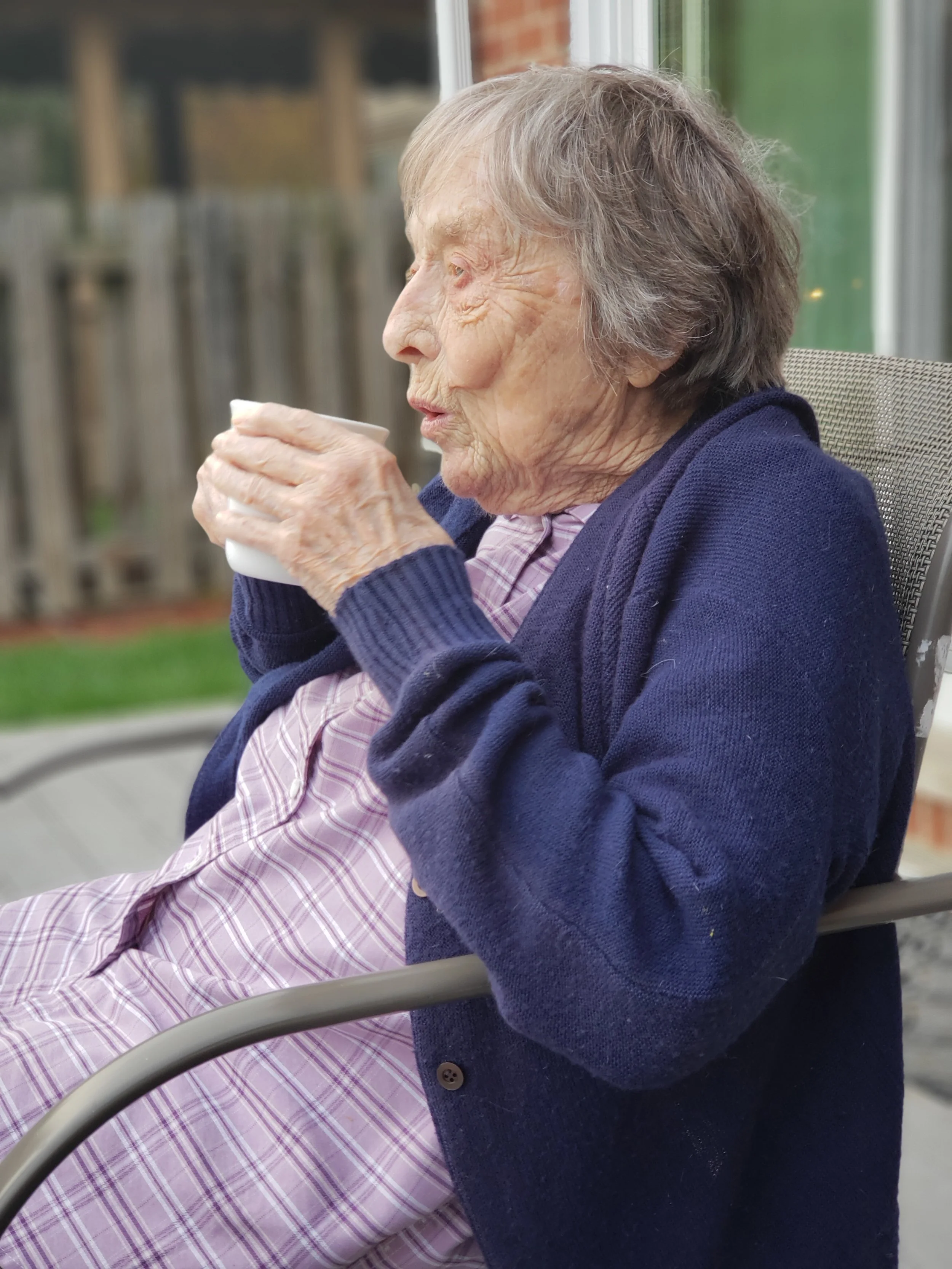
My mom, Dora Mae
I am the one caring now. And ironically, the same question has come to look me square in the eye — am I doing enough, are the choices I’m making the right ones, could something I’ve decided in love be causing a harm I can’t see. I lie awake with it. My friends tire of hearing it (no doubt).
So, there I was in the coffee aisle, stopped in front of a jar that only looked like hers, finally understanding her.
Not all of it. I would never wish the full weight of what she carried on anyone. But enough of a taste to know, at last, that her guilt was never a refusal to see the truth. It was love with nowhere left to go. It was the fierce care of a daughter who could not save her mother and could not forgive herself for being only human.
Standing there, I felt something that I had carried since high school quietly let go — the judgment, the certainty that I knew better, the young and easy belief that love should be able to talk itself out of grief. In its place came something I can only call compassion. For her. And, slowly, for myself.
If you are the one lying awake wondering whether you did enough — for a parent, a child, anyone you have loved and could not fix — I want to tell you what I wish I had known enough to tell my mother. The question is not proof that you failed. More often, it is proof of how much you loved.
And there is mercy in remembering that we were never meant to be enough on our own. The grace was always meant to come from somewhere beyond us. Scripture says it plainly: “My grace is sufficient for you, for my power is made perfect in weakness.” (2 Corinthians 12:9)
Sufficient. Even when I am not.
I never picked up the jar of coffee. I let it carry me back instead — to our kitchen table, my mother making that coffee for herself and for my grandmother the way she had so many times. The kettle. My grandma’s china cup with the pink and blue flowers. The smell of coffee rising off the pour — I caught it right there in the aisle, as real as if the pot were sitting in front of me. The small, ordinary, unremarkable care of it.
And I was there too, the way I was so many years ago. Only this time I watched it with the compassion I didn’t have then. This time I understood what I was seeing.
I am sorry, I wanted to tell her. I understand now, but you did enough — you did more than enough.
And then the harder truth, the one I am still trying to believe: I have to say the same words to myself. That whatever I am doing for my father right now, in all my uncertainty, is enough, too. That the grace I could finally give my mother, I am allowed to give myself.
For a moment, the three of us were at that table again. I stayed as long as my mind would let me.
Joy is a Catholic life coach and the founder of Rooted in Joy Coaching, where she walks alongside women standing at a threshold — a transition, a turning, a season quietly changing. If you’re being asked to grow through a season you didn’t choose, you don’t have to do it alone. Schedule a discovery call.
